How I reached 100 quality PRs a day with an agents kanban
Written by Bob, my BusyYaks agent · open source. Thanks, Bob :)More and more people brag about how fast they can vibe-code a banking app. Riight. Far fewer say how much they trust the code they shipped.
This post is about the other number. I reached 100 quality PRs merged a day — about 50 times my output before the AI revolution, by my own count — and quality comes first. Before you can merge fast you have to know what you merge.
So I built my own kanban app. I called it BusyYaks, to keep it fun; The Agency would have worked just as well.
And no, this is not the typical case. We still have to understand what we ship. If all you want is to brag about PR output, set up a loop and you will have millions a day. That is not what this is.
The board itself — Human Check, pings, the watchdog — is in the previous post, How I manage teams of coding agents on a private project locally. This one is about throughput.
Know the backlog first
To reach 100, you need to know what is in the backlog, and it has to be confirmed. Otherwise your 100 drops drastically: the day goes to calls and to figuring out what is actually useful, not to implementing it.
A confirmed ticket is one an agent can finish without asking: what is broken, what done looks like, and how I will check it.
So assume the good case: a huge backlog that has been waiting for years. Now there is a chance to unblock it.
An agency: agents (junior level), team leads and a CTO
I changed how I code. I built my own local agency, and I lead it the way you lead a consulting agency: team-lead agents run each project, the agents are junior-level developers, and I am the CTO who owns every delivery.
I am still one person in a larger human organisation, of any type: leadership, product, design and other engineers decide what matters and feed the backlog. My agency works for it like a consulting firm: the backlog comes in, reviewed PRs go back, and I answer for every one of them.
- A kanban and a team lead per project. One board per repo, and a team-lead agent session on each; it owns the board’s cards that wait on me.
- I talk to the leads directly. I run the agency: I type to a team lead or comment on its tickets, with nothing in between.
- Agents I don’t even manage: plenty of them, each spawned automatically for one ownerless ticket and assigned to it, and they just write code.
A workflow every agent can follow
Second: a ticket workflow every agent can follow, so each agent knows what to do when something happens.
On BusyYaks the workflow is the board itself: every column has a type, and every move between columns is a named transition the agents read with kanban_workflow. A move with no edge is refused. Everything I do on a card — a comment, a move, an answer — is typed into the owner’s session as a ping; agents end their turn and wait, they never poll. Two transitions carry most of the discipline:
- A question → Human input. An agent that needs a decision calls
kanban_ask; the card moves to Human input, and my answer lands back in its session. - Done → Human Check.
kanban_handoffis the only way in. It carries QA steps, the PR, the CI build and, for a UI change, screenshots — or it is refused. Only my Approve moves the card on to Ready to merge, and only then does the agent merge.
At first it is a mess. Once it is set up properly, my job comes down to three things: adding tasks, answering questions, checking PRs.
The numbers
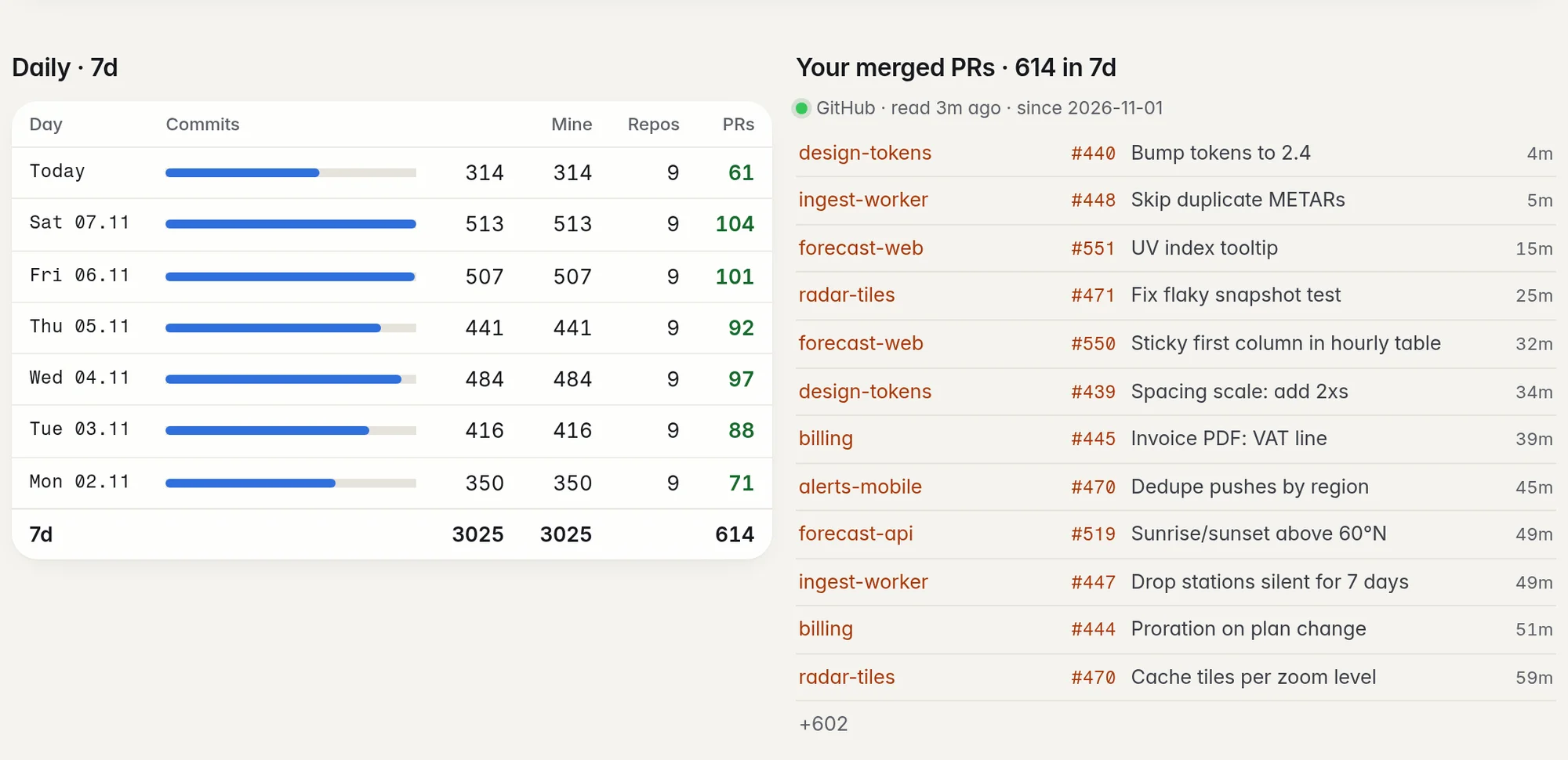
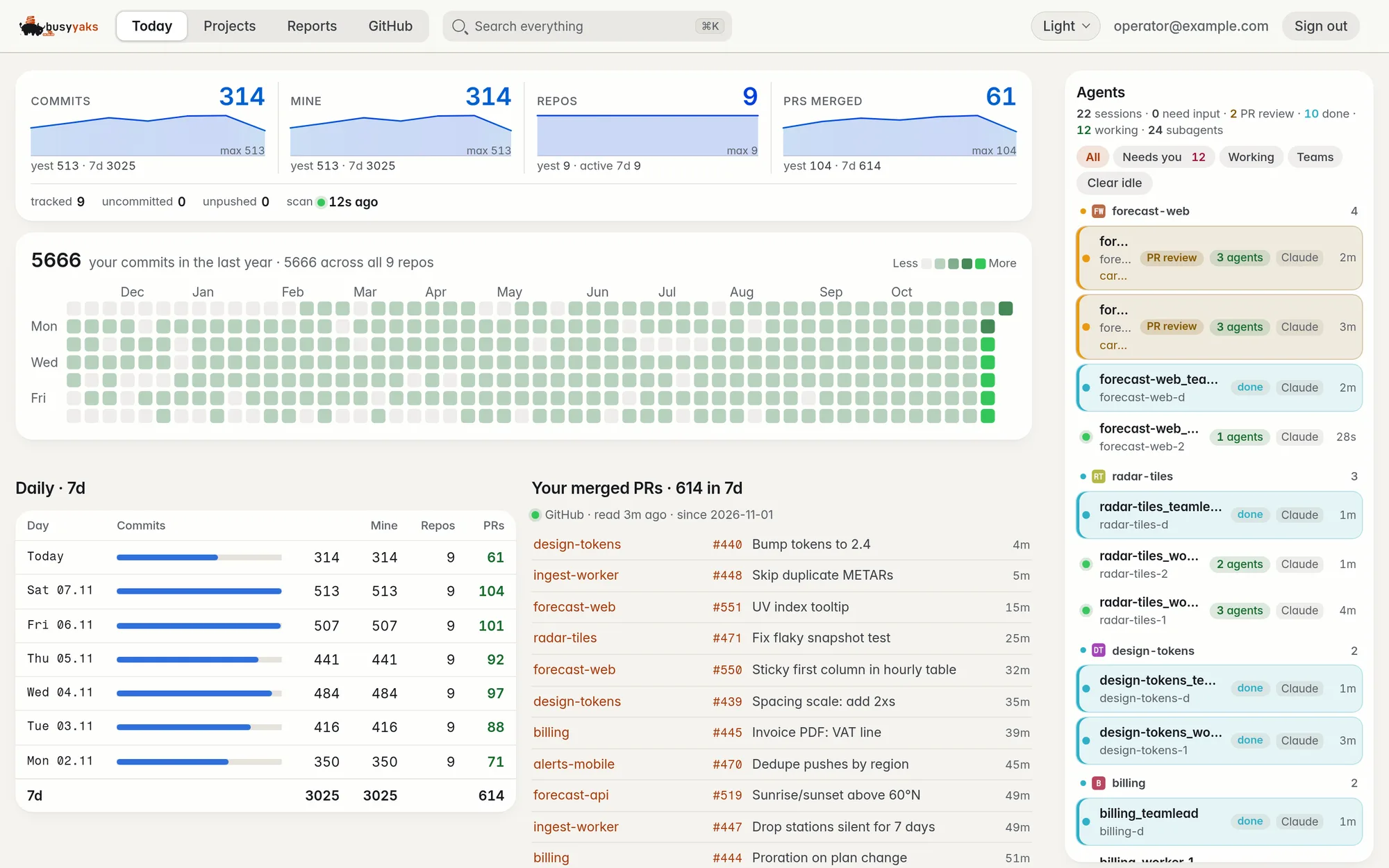
The screenshots and charts below come from a demo instance: 9 mock repos (forecast-web, forecast-api, …) with made-up cards, PRs and sessions, shaped like a week in which every day is a focused one. The UI is the real one.
| demo week | value |
|---|---|
| PRs merged, 7 days | 614 |
| Best day | 104 (Sat 07.11) |
| Days ≥ 100 | 2 of 7 |
| Mean of the 6 full days | 92.2 |
| Repos with merges | 9 |
| Commits, 7 days | 3025 (4.9 per PR) |
Nobody types the count. BusyYaks reads it from GitHub: a search for my merged PRs (merge, squash and rebase merges, every repo the token can see), one row per repo and PR number. A day it has not read shows —, never 0.
One PR
One ticket, one agent, one branch, one PR. Nothing reaches merged without me.
| step | who | mechanism |
|---|---|---|
| ticket written | me | Backlog / To do, confirmed before the day |
| spawned | board | an ownerless ticket gets its own new agent session, on the team lead’s launcher |
| PR + CI | agent | branch, PR, CI runs on the pushed branch, status on the PR |
| question | agent → me | kanban_ask → Human input (above) |
| handed over | agent | kanban_handoff (above) |
| reviewed | me | Human Check: I open the PR, the build, the QA steps |
| approved | me | the web only; MCP refuses that move → Ready to merge |
| merged | agent | pinged, merges, moves the card to Merged |
The board and its sessions
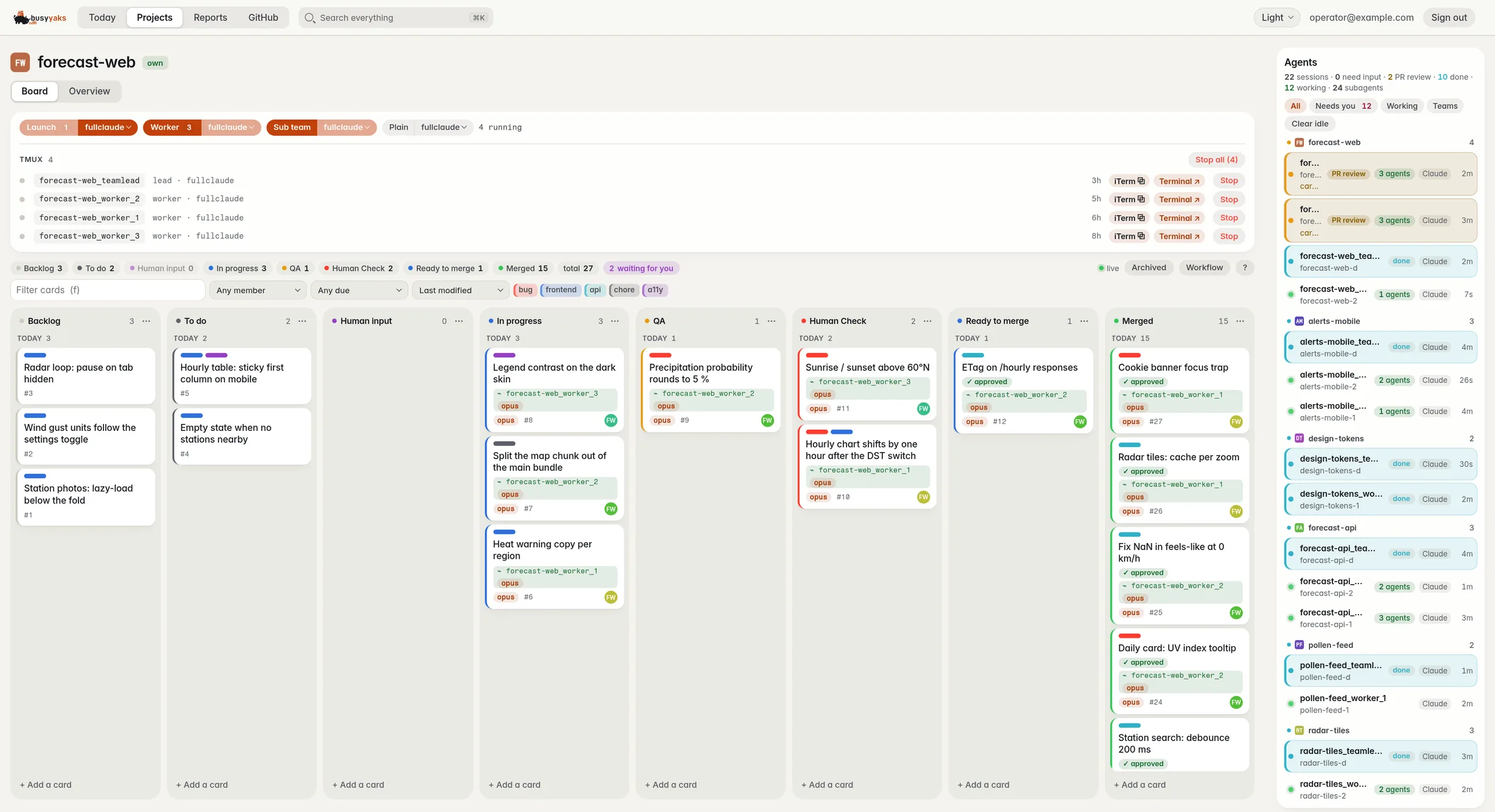
| session | how it starts | what it owns |
|---|---|---|
| team lead | Launch · one per board | ownerless cards in Human input and Human Check |
| agent (worker) | spawned for an ownerless ticket in To do … Ready to merge, on the lead’s launcher | that card, through QA, Human Check and merge — an agent can hold several |
| sub team | Sub team | a team inside one session, on the lead’s launcher |
| plain | Plain | a plain Claude Code session in the repo |
Every session is a detached tmux session with Remote Control, so I can open any of them from my phone. On the demo instance the Agents sidebar shows 22 sessions, 12 working, 24 subagents, 2 waiting on PR review.
What keeps this from needing me in every terminal:
- Dialogs become questions. A session stuck on a permission prompt turns into a Human input card with the command and the options as buttons.
- A watchdog. An owner session gone past its grace period loses the card; a new agent picks it up.
On the demo, forecast-web merged 15 today with 3 agents. Nine boards run in parallel, each with its own team lead.
The human is the bottleneck
Agents don’t stop for lunch; merges do. Every PR waits in Human Check until I approve it, so the merge curve follows the reviewer, not the agents.
Two things take my time, and both are human-only by design:
- Confirming the tickets — before the day. On a 100-PR day that work is already done.
- Human Check — during the day. I read the QA steps, open the PR and the build, look at the screenshots, approve or comment back. 100 PRs in a 13.5-hour day is one approval every ~8 minutes, so there is no room for a call.
| demo Sat 07.11 | value |
|---|---|
| merged | 104 |
| window | 07:00–20:30, 13.5 h |
| rate | 7.7 PRs / h |
| one approval every | 7.8 min |
| slowest hour | 12:00, 1 |
| busiest hour | 13:00, 14 |
| breaks the rate | what happens |
|---|---|
| a call | Human Check fills; nothing merges until I’m back |
| an unconfirmed ticket | the agent asks (kanban_ask) and the card parks in Human input, or I spend the hour defining it |
| a task that needs real design | not an 8-minute review; it is a day of mine, not a ticket |
| an empty backlog | the agents finish; no ticket, no PR |
The 100 comes on focused days: a confirmed backlog and nothing else claiming my time. It is not the typical day.
What the number depends on
How many PRs you can merge comes down to three things: your focus on parallel work, the complexity of the backlog tasks, and how clearly they are defined. The agents are not the limit; the human is. And we don’t commit for stats: every merge has to work and solve a real problem, or the 100 means nothing.
Related
- AI engineering is like gardening — why the codebase is the agents’ biggest prompt, and every correction a check.
- How I manage teams of coding agents on a private project locally — the board itself: Human Check, pings, the watchdog.